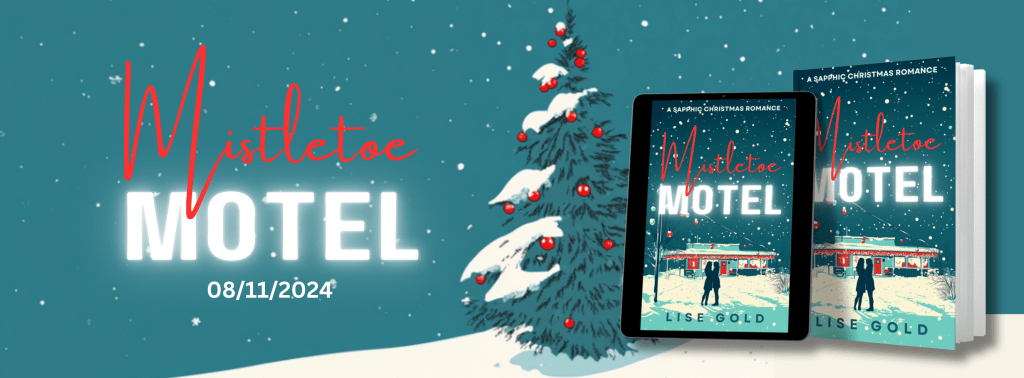
Read the first 2 chapters of Mistletoe Motel!

Chapter 1 – Mack

The crackle of the airport’s PA system cut through the low hum of conversation in Watertown Regional Airport’s small terminal. Mack Harper looked up from her laptop, her fingers freezing mid-type.

“Attention passengers,” a tinny voice announced, the speaker’s forced cheerfulness barely masking their frustration. “Due to the winter storm, we regret to inform you that all flights scheduled for the next three hours have been cancelled. We apologize for any inconvenience. Please check with your airline’s desk for rebooking options.”

A collective groan rose from the scattered passengers. Mack slammed her laptop shut, shoving it into her messenger bag as she scrambled to her feet. She wasn’t about to let a little snow keep her from making it to Minneapolis for Christmas. Her sister’s baby was due any day now, and Mack had promised she’d be there.

She joined the quickly forming line at the airline desk, her hand instinctively moving to push back her teal-dyed hair. Tapping her foot impatiently, she glanced at her smartwatch and sighed. Yes, the storm was raging outside—in fact, she was lucky they were able to land here for her change over in the first place—but if she could just get on the next available flight, she might still make it home today.

Mack stepped up to the desk, flashing what she hoped was a winning smile at the tired-looking attendant. “Hi, any chance there’s a seat left on the six-p.m. flight to Minneapolis?”

“You’re in luck.” The attendant tapped away at her keyboard. “We do have one seat remaining. Let me just—”

“Excuse me,” a voice interrupted from behind Mack. “I couldn’t help overhearing. Is there really only one seat left?”

Mack turned to see a young Asian American woman with a glossy black bob and dark eyes filled with worry.

“I’m sorry,” the attendant said, “but yes, we only have one seat available in economy. And this passenger,” she gestured to Mack, “is currently booking it.”

“Please.” The woman stepped closer to the desk, practically pushing Mack to the side. “I really need to get to Minneapolis. It’s extremely important. Isn’t there anything you can do?”

Mack felt a twinge of sympathy, but she squashed it down. “I’m sorry,” she said, trying to keep her voice neutral, “but I also need to get to Minneapolis. It’s important for me too.”

“You don’t understand. I have to be there for Christmas, and I’m a business-class passenger. I’ve paid more for my flight, so surely, that counts for something?”

Suppressing an urge to roll her eyes, Mack shook her head. “Everyone here needs to get home for Christmas, princess. Sorry. This seat is mine.”

“Don’t ‘princess’ me. How dare you! You don’t know me.” The woman’s expression hardened. “Fine,” she spat. “Enjoy your flight.”

“I’m not sure what makes her think she’s special,” Mack mumbled to the attendant, who had watched the exchange with a weary expression.

“I heard that!” the woman yelled over her shoulder as she stormed off. “Karma’s a bitch and you have it coming.”

Mack sighed and ignored the comment. “I’ll take the seat.” Behind her, she heard sighs and curses from other passengers who would be stuck in Watertown. She’d be late for dinner with her family, but at least she would make it home.

As the attendant processed her booking, Mack glanced in the direction the woman had gone. She spotted her on the phone in a corner, waving her hands around, no doubt cursing her to whoever she was talking to.

“Here you go, Ms. Harper. Merry Christmas.”

“Thank you. And Merry Christmas to you too.” Mack shot the attendant a sympathetic smile as she gestured to the queue behind her. “I hope they don’t give you too much of a hard time.”

With her new boarding pass in hand, she searched for a place to wait for her flight, but with the airport at maximum capacity, all seats were taken and she had to settle for the floor. Leaving from Seattle this morning, it had been a long day already, but she figured she’d use her time wisely to tie up loose ends at work before Christmas.

As a software engineer for a promising tech startup, Mack had been working on an innovative AI-driven personal assistant app. The project was designed to anticipate users’ needs based on their daily routines, calendar events, and even subtle changes in their tone of voice in order to assess their mental health. It was cutting-edge stuff, pushing the boundaries of natural language processing and machine learning.

The trip to Seattle had been to iron out some bugs in the speech recognition module. Mack had spent long days and even longer nights hunched over her laptop, tweaking algorithms and refining code. She’d made significant progress, but there were still a few persistent issues that needed addressing before the app could move to beta testing.

Half an hour crawled by, and then the PA system crackled to life once more.

“Attention passengers. We regret to inform you that due to worsening weather conditions, all remaining flights for today have been cancelled. The airport will be closing shortly. Our airline representatives will be available at the customer service desk to assist you with rebooking options and to provide information on discounted hotel rates for stranded passengers. We are working with local hotels to secure rooms, but please be aware that availability may be limited due to high demand. We apologize for the inconvenience and thank you for your understanding.”

The announcement hit Mack like a punch to the gut. She sat there, stunned, as chaos erupted around her. Passengers rushed to the airline desks, voices rising in anger and desperation. But Mack knew it was pointless. Long queues were already forming, and by the time it was her turn, there wouldn’t be any rooms left. She was stranded in Watertown, South Dakota, and she had to find a place to stay.

She pulled out her phone to call her sister, but the call wouldn’t go through. “Great,” she muttered, “cell towers must be down.” The airport Wi-Fi was down too, and her hotel booking app didn’t respond. While she kept trying to connect, Mack overheard fragments of conversations around her. Everyone was nervous about securing accommodations for the night. She heard mentions of the Watertown Inn, the Pine Lodge, something called the Mistletoe Motel, and several other motels outside town.

The reality of her situation crashed down on her. She needed to call her family, find a place to stay, figure out how to get to Minneapolis if the storm persisted tomorrow. Noting some people were already rushing outside toward the taxi stand, she decided she couldn’t afford to waste any more time. Not in Watertown while hundreds of passengers were stranded.

The blast of icy wind nearly knocked Mack off her feet as she stepped outside. Snow whirled around her, reducing visibility to mere feet. The world beyond was a blank white canvas, the familiar shapes of cars and buildings obscured by the relentless snowfall. The biting cold stung her exposed skin, and she pulled her scarf up over her nose.

As she trudged toward the taxi stand, her boots crunched through several inches of fresh powder. The wind howled, drowning out the sounds of frustrated travelers behind her. Snowflakes clung to her eyelashes, and she blinked rapidly, squinting against the onslaught.

The yellow glow of taxi headlights pierced through the white curtain ahead, and she quickened her pace. The race for shelter was only beginning.

Chapter 2 – Holly

Holly pushed open the door of the motel, a gust of icy wind following her inside. The warmth of the small lobby was a welcome relief, but the interior did little to lift her spirits. Her eyes were drawn to a tacky sign above the reception desk—Mistletoe Motel written in garish red and green letters.

“Welcome to the Mistletoe Motel,” a cheery woman greeted her. “My name is Maude. How can I help you?” Maude lowered her reading glasses to the tip of her nose and peered over them. Her bleached perm sat atop her head like a tightly coiled cloud, each curl frozen in place, and she wore a sweater featuring a three-dimensional Christmas tree complete with actual tiny ornaments dangling from the knitted branches

“Hi, Maude.” Holly suppressed a grin as she lowered her eyes to the nametag that said Maude Mistletoe, General Manager. “I need a room for the night.” She brushed the snow from her coat. “Please tell me you have something available.”

“That depends.” Maude tapped at her computer. “We only have Room Fifteen available, and that’s because it’s temporarily been taken out of our booking system. It needs repairs,” she explained. “But considering the circumstances, we could rent it to you at a lower rate. At least you’ll have a bed for the night.”

“Great, thank you so much.” Holly breathed a sigh of relief. After being turned away from two other hotels and an inn, she was starting to worry she’d end up having to beg strangers for shelter. “I’ll take it,” she said, reaching for her wallet.

As Maude processed her booking, Holly glanced around the reception area. “So, is it always the Mistletoe Motel?” she asked. “Or do you just change the name for Christmas?”

Maude chuckled. “Oh no, it’s the official name. But the decorations don’t go up until November. It adds to the festive cheer, don’t you think?”

Festive cheer was certainly one way to describe it, Holly thought, taking in the overwhelming Christmas explosion around her. The lobby was a cacophony of clashing colors and mismatched decorations, as if Santa’s workshop had vomited all over it.

The centerpiece was an enormous artificial Christmas tree that dominated half the space, its plastic branches sagging under the weight of countless ornaments. Tinsel in every shade imaginable was haphazardly draped over the tree, interspersed with blinking lights that seemed to be having seizures rather than twinkling merrily. At the top, a lopsided angel with a slightly sinister smile presided over the chaos.

The walls, barely visible beneath the decorations, were covered in faded wallpaper featuring a random pattern of pine trees. Strings of popcorn and cranberries zigzagged across the ceiling, intersecting with drooping paper chains and several pairs of stuffed elf legs sticking out as if they’d fallen through from the attic.

Every available surface was cluttered with an assortment of Christmas knickknacks. Snow globes of varying sizes crowded the reception desk, and a collection of nutcrackers stood guard along the windowsill.

The air was thick with the competing scents of cinnamon, pine, and what Holly suspected was a liberal application of Febreze to mask less festive odors. A small radio on the desk played “Jingle Bell Rock” at a volume just loud enough to be annoying.

The two plastic chairs in the waiting area hadn’t escaped the holiday treatment either. They were draped with red and green covers, each adorned with a small wreath that had seen better days. Between them stood a tiny table offering a plate of cookies, disposable plastic cups, and a thermos.

Despite the overwhelming assault on her senses, Holly felt a twinge of amusement. There was something endearing about the sheer enthusiasm behind the decorations, even if the execution left much to be desired. It was clear that someone—probably Maude—had poured their heart into creating this winter wonderland, however misguided the result might be.

The door behind her swung open, letting in another blast of cold air, and Holly turned to see a familiar face—the woman from the airport, the one who got the last seat on the flight to Minneapolis. Her beanie and teal hair sticking out from underneath it were dusted with snow, her cheeks flushed from the cold.

Their eyes met, and Holly felt a mixture of emotions—frustration at her situation, a twinge of guilt for how she had acted at the airport, and, she had to admit, a bit of smug satisfaction. Karma, indeed.

She turned back to Maude, taking her key card. “Sorry,” she said to the newcomer, unable to keep a small smile from her face. “Last room.”

The woman looked like she was about to burst into tears. “Are you sure?” she asked Maude. “Is there anywhere else I can try? All flights have been cancelled. The airport’s closing.”

Maude shook her head. “I doubt it. By now, the hotels in town are booked solid with stranded travelers.”

“What about a rental car?” she asked, desperation creeping into her voice. “I could try driving to the next town.”

“Car rental’s closed by now,” Maude said. “And even if it weren’t, driving in this weather would be madness, but don’t worry. There is another option,” she offered. “The church is providing shelter. You’d have to sleep on the floor, but at least you’d be safe and warm. They’ll have coffee and cake too. They’re always prepared to welcome stranded travelers during storms.”

Mack nodded slowly, seeming to accept her fate. She turned to leave, and Holly was struck by how defeated she looked. A wave of conflicting emotions washed over her. Part of her wanted to relish in this karmic twist, a petty revenge for the woman’s earlier behavior at the airport. But as she watched Mack’s shoulders slump, guilt began to gnaw at her. Holly thought about her own relief just moments ago when Maude offered her the last room. She imagined spending the night on a cold church floor, surrounded by strangers, while outside a blizzard raged. It wasn’t right. Yes, the woman had been rude earlier, but did she really deserve this? Besides, she’d been rude herself, and fair was fair. She’d been behind her in the queue, and it wasn’t just Holly who needed to get home for Christmas.

Holly’s mind raced, weighing her desire for a peaceful night alone against her conscience. She thought about her parents—devout Christians who had taught her to always help those in need. What would they think if they knew she had left someone out in the cold?

With a mix of reluctance and resolve, Holly made her decision, and before she could change her mind, she called out to her. “Wait…”

The woman turned back, surprise on her face.

“Does the room have one or two beds?” Holly asked Maude.

“There’s one bed.” Maude smiled. “But it’s king-size. Are you willing to share?”

Holly took a deep breath, hardly believing what she was about to say. “Sure. It’s only one night.” She met the woman’s eyes and shrugged. “If you want.”

The woman’s eyes widened and she stared at Holly for a beat, as if gauging if this was some cruel joke.

“I mean it,” Holly assured her, then pointed to the window. A taxi was pulling up and people were rushing out. “Make up your mind before I offer it to someone else.”

“No, I’d love to,” the woman said quickly. “Thank you, that’s so kind of you. I’d be very grateful. I just…you know, after what happened at the airport, I didn’t think you’d…” She bit her lip and winced. “Anyway, we can talk about that later. I’m Mack.”

“Hi, Mack. I’m Holly.” She wasn’t looking forward to sharing a bed with her, but it wasn’t like it could get any worse, and part of her wanted to show Mack that she wasn’t a princess.

Maude let out a shriek of joy and clapped her hands together. “Now that’s the Christmas spirit!” She prepared another key card and handed it to Mack. “We don’t serve food, I’m afraid, but there’s a convenience store nearby, and I’ll ask housekeeping to bring some extra coffee, tea, and instant cocoa to your room. She’s on her break now, but she’ll be back shortly.”

“Thank you, Maude. You’ve been amazing.” Holly hesitated as she swung her weekend bag over her shoulder. “Just out of curiosity…what’s wrong with the room? Is the toilet in working order?”

“Yes, the toilet and electrics should be fine,” Maude said. “Just some damages to the interior, but nothing that will keep you from a good night’s sleep.” She leaned in, lowering her voice. “And don’t you worry about a thing, girls. Either my husband or I will be at the front desk all through the night. If you need anything at all, just come on down and we’ll take care of you.”

Like this sample? You can pre-order Mistletoe Motel here:

Read the first three chapters of Songbirds of Sedona

Chapter 1 – Gemma

I deserve to be here. That’s what I keep telling myself when things get tough, and today is a tough day. I took a life. I deserve this.

I’m reading the card that arrived in the mail this morning, fighting the wave of emotions that always comes with any contact from the outside world.

“Happy Birthday, honey,” the card reads. “I wish you would let me visit today. Just know that I’m thinking of you. Hang in there. Not long to go now. Love always, Mom.”

I feel tears prick at the corners of my eyes, but I blink them away. Crying is a weakness I can’t afford to show here, so I’ve learned to keep my emotions locked away. It’s the only way to survive.

I appreciate my mother’s words, but they also sting. Not long to go now. It’s bittersweet. Even a day in this place feels like an eternity, and now another year has passed. Another year wasted.

The buzzer sounds with an ear-piercing screech, jolting me out of my bunk. It’s lunchtime at Perryville Prison. I put away the card, rub my eyes, and pull on my navy blue scrubs and white slip-on shoes. The fabric is coarse and worn thin from too many washes. My cellie Tonya is snoring softly on the bottom bunk, and I nudge her awake before I shuffle out into the concrete hallway already swarming with inmates.

I join the throng of women in blue flowing toward the cafeteria, careful to keep my distance and eyes fixed straight ahead. You learn fast in here not to make eye contact unless you’re looking for trouble. The noise builds as we march through the double doors into the massive, high-ceilinged dining hall. Fluorescent lights buzz overhead, glinting off the stainless steel tables bolted to the floor in uniform rows. 

I grab a red plastic tray from the stack and get in line, inching slowly forward as the kitchen workers, inmates themselves in white aprons and hairnets, slop food onto each tray. Today’s lunch is a cold bologna sandwich, potato chips, beans, a bruised apple, and Bug Juice, the overly sweet red drink that claims to be “fruit punch.” My stomach protests, but I’ve learned to choke this stuff down.

Tray in hand, I scan the cafeteria for a safe place to sit. Perryville is worse than Lumley Max where I spent the last six years before being transferred here a year and a half ago. At least in Lumley, I had the protective walls of my private cell twenty-one hours a day. I only had to deal with other inmates during chow time and rec hour in the yard.

Here in Perryville, a mediumsecurity prison, there’s a lot more “freedom.” Our cells are left unlocked most of the day so we can access the day room with its worn couches and staticky TV. We can sign up for classes and job assignments to earn time off our sentences. But with the additional privileges comes more risk. More time to interact with unpredictable inmates and end up in fights that could send me to the hole or get more time tacked onto my sentence. I’ve seen it happen and I’m determined to keep my head down. I’ve got six weeks left on my ninety-two-month sentence and I’m not going to blow it now.

I finally spot an empty table in the corner, far away from the cackling cluster of Norteñas gang members holding court near the cafeteria entrance. I keep my back to the wall as I sit down, always vigilant. My eyes dart from table to table, marking potential threats. You never really relax in prison.

There’s the cadre of meth heads with their pockmarked faces and jittery fingers drumming the tables, twitching for their next fix. They’re mostly in for drug offenses, burglary, identity theft—the things addicts do to get money for that next hit. I steer clear of them and their drama.

Then there’s the OG lifers, mostly in their forties and fifties, in for violent crimes. They look hard, joyless, their faces etched from decades behind bars. But they keep to themselves unless you cross them. I give them a wide berth.

At the next table over is a group of young women, barely eighteen. The detention officers call them “babies.” They’re pretty, with their long hair and thick eyeliner. They’re giggling and throwing food at each other. They haven’t been in long enough for this place to grind them down.

A tray clatters down across from me and I nearly jump out of my skin before I register it’s just my cellie, Tonya. She grins, flashing the gold front tooth I’ve never asked about.

“Gemma. Damn, girl, you look more uptight than usual today,” Tonya says, digging into her bologna sandwich.

“Just counting down.”

“Eyes on the prize,” she says. “And then what?”

“I haven’t figured that part out yet,” I mutter. “I suppose I’ll have to move in with Mom until I find a job.” The thought alone exhausts me. Not because I don’t want to work, but it’s no secret how hard it is to find a job with a conviction. Especially one as serious as mine.

“Same,” she says. “I’m moving in with my cousin to look after her children while she’s at work and I might look for a job in a coffee shop since I’m a certified barista now.”

“You finished your training? Congratulations.”

“Yeah. Just in time. I figured I’d need something to fall back on.” She regards me. “Are you going back into real estate?”

“No chance. No company would hire me, but I’m hoping to find a job as an electrician.”

Tonya chuckles. “Oh yeah, I forgot you got your degree.”

“Why is that so funny?” I ask, arching a brow at her.

“I don’t know. It’s just…” Tonya looks me up and down. “You look nothing like an electrician. I’d peg you for a beautician with your long hair and flawless skin.”

I shrug. “The course gave me something to do, but again, it’s unlikely someone will hire me, so I might start my own business and hope for the best.”

“You’ll get there,” she says. “We both will.”

Tonya’s been somewhat of a friend to me since I transferred to Perryville, as much as you can have friends in here. More of an ally. Someone to watch your back. We keep each other sane, make sure neither of us catches a disciplinary case that will delay our release. She’s short-timing it too and will be out a few weeks after me.

We eat quickly, talking through mouthfuls. In prison, you learn to devour your food before someone bigger and hungrier comes and takes it from you. Mealtimes are when trouble starts, as the chow hall is one of the few places where rival gang members can get within striking distance of each other. The detention officers patrol the aisles, but things happen fast. Trays start flying, and if you’re not careful, you can catch a blindside blow to the head and wake up in the infirmary.

I keep my head on a swivel as I force the food down. The trick is to look aware without looking scared. Here, fear is like blood in the water; it draws the sharks. You have to armor yourself in a hardened facade, even if you’re quaking inside.

“This is gross,” I say, scraping the last of the beans from my tray when a commotion breaks out across the cafeteria. An alarm blares and a swarm of detention officers sprint toward a heap of flailing limbs and guttural screams on the floor.

Tonya looks up. “What’s going on?” Two women are ripping into each other, blood spattering the white tiles. I can’t make out who they are before the guards wrench them apart and haul them off, still kicking and cursing.

The alarm shuts off and a deafening silence follows. Every eye follows the guards as they march the two prisoners out, each held firmly by an arm. The rest of us keep our eyes down and mechanically continue eating as if nothing happened.

A few minutes later, the guards bark at us to line up and clear out. I bus my tray and take my place in line. I was hopeful when I first got transferred here. I thought things would be better, easier. Now I know there’s no such thing as an easy prison bid. You just trade one set of dangers for another.

Chapter 2 – Lori

The tires crunch on the gravel driveway as I pull up to the farmhouse, dust billowing in my wake. I cut the engine and for a moment, I sit in silence, staring at the property that is now mine.

My friend Charlotte gets out of her car behind me and I follow suit.

“It looks just like I remember, only a bit more weathered. And bigger,” I say, trying to inject some optimism into my voice. “My new home.”

Charlotte peers at the farmhouse through oversize shades, her glossy black ponytail swishing as she cocks her head. “It’s got potential, Lor. A little TLC and this place could be gorgeous.”

“I’m not so sure about the ‘little’ part.” I bite my lip as I study the peeling white paint and sagging porch. When Aunt Maggie left me her farmhouse and orchard in her will, I had visions of living in a quaint, idyllic hideaway. A place to start fresh after leaving my controlling ex and quitting my soul-sucking corporate job. Confronted with the reality, I feel a swell of doubts. I haven’t been here in thirty years, and I’ve clearly romanticized it in my head.

With a fortifying breath, I head to Rosefield Farm with Charlotte on my heel. We follow the overgrown path to the front porch, and I fumble with the unfamiliar keys before finding the one that fits the rusted lock. The door creaks open, revealing a dim interior that smells of dust and neglect.

“Oh…” Charlotte winces as she peers in. “How long has it been empty?”

“A year,” I say. “Aunt Maggie got sick and had to go to a home. She didn’t have kids or close family apart from my mother, so no one’s been here since. I didn’t even know she’d passed away until I got the call a few months ago.”

I step inside, my footsteps echoing on the hardwood floors. Faded floral wallpaper peels above the chair rails. A layer of dust coats every surface like a shroud. Charlotte moves past me, her heels clicking decisively as she throws open the heavy brocade curtains, sending dust motes dancing into the sudden flood of light.

“These windows are amazing,” she says, gesturing to the ceiling-height casements that overlook the orchards. “You’ve got a killer view.”

I join her at the window, taking in the neat rows of trees across the landscape, the red rocks of Sedona rising behind them in the distance. It looks like a postcard, but all I can think about is how much work those hundreds of trees must need.

“I don’t know the first thing about growing fruit,” I admit, my voice small. “What if I kill the trees? They’re probably dead already. No one’s been taking care of them.”

Charlotte spins to face me, hands on her hips. “They don’t look dead to me, and you’re not going to kill anything. How hard can it be?”

I raise an eyebrow. “Harder than being an attorney, I’m guessing. At least for me.”

“You hated that job,” Charlotte reminds me. “This is your chance for a totally different life, so just sit back and let nature do its thing.”

I wish I had Charlotte’s breezy confidence. But then, she’s not the one who just staked her entire future on a farm she knows nothing about.

We continue our exploration, moving from room to room. The kitchen looks like a time capsule from the 1970s with its mint-green refrigerator and Formica countertops edged in chrome. I open the oven and a family of mice skitters out, making Charlotte and me yelp and jump back.

“Okay, so it needs some updating,” Charlotte says, warily eyeing the dark recess of the oven.

That’s an understatement. The linoleum floor is gummy with decades of grime. The sink is stained with rust, and I don’t even want to think about what the bathroom looks like.

We drift back into the living room with its hulking stone fireplace. I run my hand along the mantelpiece, raising a layer of dust. Above the mantel, a large painting depicts the farm in its prime—rows of trees heavy with apples, peaches, and pears, and a golden sun hanging low over the hills.

“I was eight last time I visited Aunt Maggie and Uncle Frank. They were so proud of their farm.”

“What happened?” Charlotte asks. “Why did you lose contact?”

“My mom had a fight with Aunt Maggie. It must have been a serious one because she broke off all contact, and with that, I lost contact with them too. I could have visited later, when I was older, but by then, I felt so far removed from them that I never did.” I sigh. “I feel guilty about that now.”

“But they didn’t try to contact you either, right?” Charlotte squeezes my shoulder. “Whatever happened. Maggie wanted you to have the farm, so you must have had a special place in her heart.”

“She didn’t have much choice,” I mumble. “Apart from Mom, she didn’t have any other living family members.” I blow out my cheeks as I tally the repairs—the outdated electrical work, the stained walls, the chipped paint around the windows. Not to mention all the work the orchards likely need. New trees planted, old ones pruned. And what about irrigation? Pest control? Harvesting? My head spins with all the unknowns.

I sink onto the sofa, sending up a puff of mustiness. “I’m in over my head, Char. I thought I’d have enough savings to fix the place up, but this is beyond a cosmetic update. The plumbing, the electric…it’s too much.”

Charlotte plops down beside me, nudging me with her shoulder. “Hey. You’re doing something really brave, you know that?” She looks me square in the eye, her expression earnest. “And you’re not alone in this. I’m here. I’ll help however I can. We’ll rally the troops and throw a painting party. We’ll hit up yard sales for furniture. Poco a poco, right? You’ve got this. And it’s clear you can’t sleep here tonight. Not until we’ve done a thorough clean, so you can stay with me until it’s a little more livable.”

“Thanks, Char. I honestly don’t know what I’d do without you.”

“Let’s hope you never have to find out,” she says, flashing me a cheeky grin. She hops to her feet, offering me her hands. “Now, let’s see what kind of treasures Aunt Maggie left upstairs. I’m feeling vintage chic decor vibes.”

Laughing despite myself, I let her pull me up. She threads her arm through mine as we climb the creaky stairs. The whole house seems to exhale, as if it’s been holding its breath for a long time. I know the feeling.

As I open the curtains in the master bedroom, dust swirls in the slants of light from the grimy dormer windows. The bed is made up and a hairbrush lies on a dressing table. The sight makes me sad, so I turn my attention to the wardrobe where I find Aunt Maggie’s clothes. “It looks like most of her stuff is still here. I think she was expecting to return to the farm.”

“Poor Maggie.” Charlotte flicks through the garments. “She had some nice clothes. You could definitely sell these online.” She puts on a silk dressing gown and strikes a pose. “I’ll be your model.”

“I might have to take you up on that offer,” I say. I sold a ton of stuff when I moved out of my ex’s apartment in Prescott. I wanted to start fresh with as little clutter as possible, but now I’ve inherited ten times more. “Let’s check out the other rooms.” I pull Charlotte along, and she sneezes explosively as we enter another bedroom, the sound muffled by the insulating press of old clothes, stacked paintings, and shrouded furniture. It’s like an antique store exploded in here.

“Looks like Maggie had a hoarding room.” She rubs her hands together. “Let’s get to rummaging!”

For the next hour, we pick through Aunt Maggie’s belongings, unearthing a rusty birdcage, a gilt-edged mirror, a chipped enamel bread box. Charlotte dives into a trunk of clothes, emerging with a faded calico dress and straw sun hat.

“Oh my God, Lor!” She pulls the dress over my tank top and shimmies it over my shorts. “It’s straight out of Little House on the Prairie! This is so your farmgirl aesthetic!” She plops the sun hat on my head at a jaunty angle before stepping back to assess the effect. “Yep, it’s official. Farmer Lori is in the house! Those chickens won’t know what hit ’em!”

“There are no chickens,” I remind her, laughing as I straighten the hat. “It’s a fruit farm, remember? And I think you’re more farm-girl chic than I am.”

She purses her lips. “You know what? I could totally rock the gingham and clogs.”

We dissolve into giggles just as her phone chimes from her back pocket. She wrestles it out and glances at the screen, her grin fading.

“It’s work. Some emergency with the Barton account.” She heaves a sigh. “I’m sorry, Lor. I have to deal with this.”

A pang of guilt twists in my stomach. Here I am, running off to play farmer while Charlotte picks up my slack at the office.

“Hey,” she says, reading my expression. “I’m thrilled to cover for you, and a new guy is starting next week so things should calm down.” She pulls me into a hug that smells of L’Occitane. “You’ve got this,” she murmurs in my ear. “Poco a poco, remember?”

We head back downstairs and out into the afternoon sun. The orchard shimmers in the heat, the leaves on the apple and peach trees trembling like a mirage. Cicadas drone in the brush, and the air smells of baked earth and the slightly fermenting tang of fallen fruit.

Charlotte pauses beside her sleek Audi parked behind my sensible Corolla. Her oversize sunglasses are back in place, but I can still see the concern pinching her brow.

“You sure you’re going to be okay out here today?”

“Yeah. I’ll be fine,” I say, glancing at my car that’s packed to the brim. “I’ll unload and drive back and forth to the storage a few times. I want to get that out of the way first.”

“Sure. Well, you have my key, so just let yourself in,” Charlotte chimes before waving me off. “I’ll see you later.”

She drives off and then it’s just me. Just me and rows upon rows of trees and a ramshackle house full of ghosts and dust. I take a deep breath, the hot, dry air searing my lungs. I have no idea what I’m doing. No idea if I can actually pull this off. I left a successful career for an unknown life, and I don’t even know where to start. Poco a poco, I remind myself, and open the trunk to my car.

Chapter 3 – Gemma

The sun beats down mercilessly as Tonya and I walk slow laps around the yard. The recreation area is a stretch of flagstones hemmed in by towering razor-wire fences that glint menacingly in the harsh Arizona light. There’s a handful of metal picnic tables bolted to the ground, their surfaces hot enough to blister skin, and a few withered patches of grass that crunch beneath our feet.

Despite the oppressive heat and the watchful eyes of the guards, I cherish this small slice of outdoor time. After so many years, the bleak yard feels like a gift, a tiny taste of freedom.

Tonya fans herself with her hand, her dark skin gleaming with sweat. “Girl, it’s hotter than Satan’s armpit out here.”

I nod in agreement, wiping my brow with the back of my hand. It’s rare to have a heatwave so early on in the year, and the air shimmers, distorting the figures of the other inmates trudging around the yard.

We keep walking, hugging the perimeter. Yard time is when all the prison politics play out, when scores get settled, deals get done, and pecking orders get reinforced. I’ve seen fights break out in a blink, and although Tonya and I do our best to steer clear, sometimes trouble finds you whether you’re looking for it or not.

Case in point—the new girl, a beefy redhead with sleeve tattoos and a hardened stare, is headed straight for us. She’s been throwing her weight around since she got here last week, trying to assert herself as top dog.

I tense as she approaches, my footsteps faltering. Tonya shoots me a warning look. “Eyes forward. Keep walking.”

But the new girl has other ideas. She veers into our path at the last second, her shoulder slamming into mine with enough force to bruise. I stumble, biting back a yelp of pain.

Tonya catches my arm, steadying me. She glares at the new girl’s retreating back. “Bitch,” she mutters under her breath.

I rub my throbbing shoulder, my heart hammering against my ribs. A part of me wants to whirl around and confront her, to show her I’m not some pushover, but I force myself to keep walking. I can’t afford to catch a case, not now when I’m so close to the door.

“Just ignore her,” I mutter. “We’ll be out soon. She’s not worth it.”

Tonya shakes her head. “Damn straight. I can’t wait to walk freely without bitches like her making me look over my shoulder twenty-four seven.” She sighs. “What’s the first thing you’re going to do when you get out?”

“Hmm…” I smile. “You first.”

A slow grin spreads across Tonya’s face. “Fried chicken,” she says matter-of-factly. “A whole bucket, extra crispy. And then I’m going to find me a man and ride him like a buckin’ bronco.”

I snort with laughter, picturing Tonya tearing into a drumstick, grease dripping down her chin while ogling men. “Food and sex, huh? You’ve thought about this.”

“Of course. Haven’t you?” She waggles her eyebrows. “Hey, a girl’s got needs! Two years is a long time.”

I can’t argue with that. My time inside has felt like an eternity, and the ache of loneliness is a constant companion, as familiar as the scratchy sheets on my bunk.

Tonya nudges me with her elbow. “Your turn. What’s top of your list?”

I tilt my face toward the cloudless sky, squinting against the brutal glare of the sun. “Being outdoors. Like really outdoors, not just this cage. Feeling grass under my bare feet. Watching a sunset.”

“Mm-hmm. And what else?”

“A long, hot shower in a bathroom with a door that locks and my favorite shampoo and shower gel. And no one timing me or yelling at me to hurry up.”

Tonya makes a low sound of agreement. “Amen to that. I’m going to soak in a Jacuzzi till I turn into a prune. I’ve just gotta find me a man who has one,” she jokes.

We walk in silence for a bit, both lost in visions of the luxuries we once took for granted.

Then Tonya gives me a sly look. “You didn’t mention sex. Or dating.”

I keep my eyes fixed on the sky, my jaw tight. “Nah. I think I’m done with all that. Relationships. Love. It’s brought me nothing but trouble.”

“Men can be dicks,” she says.

“So can women.”

Tonya frowns. “What? You’re gay?”

“Yeah. Is that so surprising?” Now that I’m close to getting out, I don’t care if she knows, and I don’t think she’ll tell anyone.

“Kind of. You look so straight. Like I said, I pegged you for a beautician.”

I can feel Tonya’s gaze boring into the side of my face, curious and intrigued. I don’t talk much about my life before Perryville, about what landed me here. Most people assume it was drugs. I’ve never corrected them.

I don’t tell Tonya how I fell for a woman with a smile like the devil and a temper like a volcano. How she could make me feel like the center of the universe one minute and a worthless piece of shit the next. How I thought I could fix her, change her, how I kept forgiving and forgetting, just like my mother used to. Until I became a ticking time bomb of anxiety. I don’t tell her about my mother’s abusive boyfriend, that last night when my anxiety got the better of me and my world blacked out. When I caught him attacking my mother, when I hit him over the head with the first thing in sight. When the world turned red and wet and my future shattered in a single, irrevocable instant. I don’t tell her what I’m capable of.

“I miss pizza too,” I say instead, changing the subject. “And wine.”

“I’m with you on the pizza,” Tonya says. “But I’m done with drinking. Like women for you, alcohol has done me no favors, and I’m going to be a better person. Third time lucky.”

“Third time?” Her comment makes me realize how little we know about each other. I always assumed it was her first time in prison; our conversations have never been that personal until now, until the end was in sight. “I didn’t know.”

“Yeah, there’s a lot we don’t know about each other. I’ve been around. Done bad stuff. Not bad-bad though,” she corrects herself. “It’s not like I killed anyone.” I flinch, but she doesn’t notice. “Do you think we’ll see each other when we’re out?”

“I hope so,” I say honestly, because Tonya is the closest thing I’ve had to a friend in the past seven years and six months. Before I did what I did, I—a squeaky-clean realtor—would never have exchanged a word with someone like Tonya—a streetwise serial offender. But in here, in the confines of these concrete walls, we’re all the same. Names reduced to numbers etched on uniforms. The lives we once led, the identities we claimed, stripped away like layers of weathered paint.

I always believed I was different. I navigated a world of manicured lawns and polite chitchat, my growing pain and anxiety hidden beneath a smile. I looked at the faces of the condemned on the evening news and thought, That could never be me.

But I’m no different. Prison has a way of distilling us down to our rawest elements. Here, there is no pretense, no artifice. The labels that defined us on the outside—mother, daughter, wife, criminal—fade away, leaving only the essential truth of our humanity.

“How about ice cream?” Tonya asks, unaware of my mental reflection. “We could meet up and get ice cream together. What’s your favorite flavor?”

Before I can respond, a sharp whistle cuts through the shimmering air. “Yard time’s over, ladies! Line up for count!”

Tonya and I exchange a rueful look before falling into line with the other inmates. As we wait to be ushered back into the bowels of Perryville, I stare out at the sky over the razor wire.

I’ll walk out of here soon. I’ll step into the blinding Arizona sun a free woman. But a part of me will always be imprisoned by the choices that brought me here. By the things I’ve done that I can never undo.

The heavy metal door clangs shut behind us as we shuffle back inside, and the AC hits my sweat-slicked skin, raising goose bumps on my arms. My armpits and back are sweaty, and my shrubs will smell as soon as the synthetic fabric dries. I’m dying for a shower but I have to wait another four hours to scrub off the remnants of the day so I can feel clean again. A deeper part of me knows better, though. Knows that some stains never come out, no matter how hard you scrub.

Like this sample? Get Songbirds of Sedona on pre-order here. Out 31/05/2024.

https://www.amazon.com/Songbirds-Sedona-Lise-Gold-ebook/dp/B0D54GQ78B/ref

Read the first 3 chapters of ‘In Dreams’

Chapter 1

Nestled in the heart of Notting Hill, London, on the second floor of a mews house, lay the office of Emma Parker, psychologist to the stars turned dream coach. Rebecca glanced up at the building that looked just like the pictures she’d seen online: pastel pink with white windowsills and bright pink geraniums in the plant pots by the entrance. Tucked away in one of the quaint, terraced buildings, there was no sign of a business apart from the small plaque next to the doorbell that said, London Dream Clinic. Rebecca felt nervous as she rang the bell. Dr Parker’s long waiting list had given her months to anticipate her first appointment, but she still had no idea what to expect. Finally, the day had come, and she sincerely hoped Dr Parker lived up to her reputation as she was getting more tired by the day and waking up at five am to head for the studio had become a challenge. On top of that, fatigue was starting to show on her face, and make-up couldn’t disguise the bags under her eyes anymore.

Working as a morning TV presenter and being in the public eye, viewers had started to question her well-being, and she didn’t like the gossip that was spreading over social media. The door buzzed, and Rebecca let herself in. The narrow staircase leading up was steep and a little worn, with chipped paint on the walls and a damaged wooden handrail that had come loose in places. Definitely not an entrance to a three-hundred-pound an hour clinic, she thought when she reached the second floor and took a moment to steady her breath before knocking on the door. After trying just about everything, Dr Parker felt like her last and only hope, and desperate to solve her sleeping issues, she mentally braced herself for her session.

“Hello, Rebecca. It’s nice to meet you. Please come in.” Dr Parker smiled as she opened the door wide. Rebecca was still out of breath, and she put a hand on her shoulder. “Sorry about the stairs. It’s an old building.”

“No problem. I’m just out of shape; I haven’t had the energy to go to the gym lately.” When Rebecca entered her office, she noted the woman was nothing like she’d imagined. From the stylish black and white headshot of Dr Parker – the only photograph on her website in which she wore a simple, black turtleneck with her hair slicked back into a blonde ponytail, she was surprised to find that this woman looked quite the opposite. Dressed in an oversized grey jumper, black leggings and white trainers, and her long hair gathered into a messy bun, she could have come straight from the gym. At first sight, there was nothing remotely slick or pretentious about her. “You look so different in real life.” Rebecca looked her up and down. “I mean, not in a bad way,” she quickly added. “Just different.”

“I get that a lot. I need to update my website, but it’s not urgent so I keep putting it off.” Dr Parker gestured to a deep, white three-seater couch with knitted throws draped over the backrest. “The photograph on my website is at least fifteen years old, taken at a time when I was trying a little too hard to establish myself professionally.”

“You certainly succeeded,” Rebecca said, pleasantly surprised that her new therapist didn’t shy away from sharing such personal information.

The old, white-washed wooden floor creaked under her feet as she crossed the space with tall windows. The room felt light and romantic, as if dreams themselves were woven into the very fabric. Soft, pastel hues adorned the walls, and delicate fairy lights twinkled around the open beams, casting a soft, ethereal glow that danced across the ceiling. The scent of lavender and vanilla lingered, and a vintage sideboard was standing against the left side wall, its surface adorned with an assortment of journals and well-worn books. A huge, intricately designed dreamcatcher hung above it, its delicate feathers swaying in the breeze of the open windows. Crystals of various shapes and sizes were displayed on the windowsills, capturing and refracting the sunlight and infusing the space with a touch of mysticism. A plush armchair stood opposite the couch, and in between was a low, wooden coffee table. Thick, neutral-coloured rugs were randomly scattered over the floor, and dream-inspired artworks graced the walls, depicting ethereal landscapes and surreal scenes.

Rebecca took in every detail, fascinated by how much everything went against her expectations. “I love your office.”

“Thank you. I’ve tried to make it as comfortable and inviting as I could. I spend a lot of time here, after all.” Dr Parker grabbed two mugs from a small cabinet that held a coffee maker and a kettle. “Coffee? Tea? Or I have sparkling water if you prefer…”

“Oh, I’d love a coffee,” Rebecca said gratefully. “I didn’t think you’d have any, and the coffee shop around the corner was already closed for the day.”

Dr Parker chuckled as she turned on the Nespresso machine. “Hey, just because I’m specialized in sleep patterns and dreams doesn’t mean I’m the coffee police. I love a good cuppa.” She put two mugs with black coffee on the table along with a small jug of milk and a bowl of brown sugar cubes. “Do you mind if I call you Rebecca? Or do you prefer Ms. Pandey?”

“No, Rebecca is fine.”

“Excellent. I prefer to keep it casual too, so please call me Emma.” Emma grabbed a notepad and a pen from her coffee table and sat back in the armchair. “I like to use pen and paper in my sessions, then I’ll type out my notes later. You’re welcome to read anything I write if it makes you feel more comfortable, and our sessions will, of course, remain strictly confidential.” She tapped her notepad a few times and studied Rebecca with curious eyes. “I’d normally start with asking you what you do for a living, but I happen to religiously watch ‘Tails and Tales,’ so I might as well admit that.”

“Oh… You watch my show?” Rebecca’s brows shot up. “You don’t fit the profile of my audience pool. It’s not exactly highbrow,” she said with a hint of humour. She felt flattered that Dr Parker knew who she was, and even more so that she liked the morning TV programme that she presented and co-produced.

“Quite the opposite. I enjoy it. It’s cute, positive, and entertaining.” Emma shrugged. “Animals always make me laugh. I have a cat myself, and I share a dog with my ex. My cat, Penny, is an exceptionally good thief who steals all kinds of things when my neighbours leave their windows open.”

Rebecca sniggered. “You should sign her up for the programme. I’m personally involved in the selection, and we’ve never had a kleptomaniac cat before.”

“I’m afraid she doesn’t steal on command, and I certainly don’t encourage her,” Emma joked. She opened her notepad and smiled. “Anyway, enough about Penny. As much as you seemed to have a pre-conceived idea of me, I probably have one about you. That’s what happens when you see someone on TV every day. You think you know them, but you don’t, so why don’t you start telling me a little bit about yourself? Your family, your upbringing, your personal life, your routine… Just so I can get to know you a little. After that, we’ll delve into your issues.”

“Okay.” Rebecca’s nerves subsided as she stirred sugar through her coffee and took a sip. Emma made her feel at ease and the session felt casual so far, like she was talking to a new friend. “I was born in London to Punjabi parents. They immigrated from India after they got married and I’m the youngest of three children; I have a brother and a sister. My mother was a housewife, or a homemaker as they say nowadays, and my father was a physiotherapist and he’s retired now. I have a good relationship with my parents and siblings…” she hesitated. “Well, as good as it can be, I suppose. My siblings are all married with children, and I’m the only one apart from one uncle in the family who never got married.”

“Was that ever an issue to them?” Emma asked.

“Yes, it was a struggle when I was younger. They pressured me to find a husband; they’re quite traditional that way, but I fought hard to follow my own path. I studied journalism and made it very clear to them that my career came first, and they finally gave up on the idea of me becoming a wife and mum anytime soon. I dated a few men, had two long-term relationships, and was even engaged to one of them, but I called it off as I didn’t feel marriage would give me as much happiness as my independence did. Breaking off the engagement was difficult. My parents and my fiancé’s parents were close, so it caused a lot of drama.” Rebecca winced, remembering the awful fights they’d had and how she’d nearly lost all contact with her parents. “But that was a long time ago and now we’re fine. We argue, of course; I think every family does, but nowadays we bicker about insignificant things rather than big life choices.”

Emma nodded. “So, would you say your personal life is fairly stable?”

“Yes,” Rebecca said. “My sister had breast cancer, but she got the all-clear last year, and since then, there’s been very little drama.”

“That’s good.” Emma jotted a few things down before she looked up again. “And are you currently in a relationship?”

“No. Even if I wanted to, my job is hectic and I’m always tired, so I prefer to spend my weekends alone in bed.” Rebecca held up a hand. “That doesn’t mean I’m a loner. I have dinner with my family twice a week, and I often see friends or colleagues for a late lunch after work.” Leaning back and crossing her legs, she realized that, apart from her sleeping problem, her life was actually pretty good. “All in all, I’d be happy if it wasn’t for my lack of sleep wearing me down.”

“And that is why you’re here.” Emma leaned forward and shot her a reassuring smile. “I can help you with that.”

Chapter 2 – Emma

Emma liked Rebecca. She possessed a certain sweetness and innocence, a vulnerable quality not evident on TV, where confidence was her public persona. Dressed much like her morning programme attire, Rebecca appeared even prettier without makeup. Emma had only seen her shoulder-length dark hair straightened, but today it held a natural wave as if left to dry in the wind after a shower. In dark jeans, sneakers, and a navy blazer with a white T-shirt underneath, she effortlessly exuded a smart look. Yet, what truly stood out were her green eyes, even more intense in person, lighter with a speck bordering on yellow running through them.

Although Emma had had many celebrity clients over the years, her disinterest in gossip magazines and limited TV watching usually made her oblivious to their fame before their first meeting. However, with Rebecca, she felt a genuine intrigue and, admittedly, a keen interest that wasn’t purely professional.

“Now that I know a bit about you – and thank you for sharing – I’ll tell you about myself and how I work,” she said, clearing her throat and taking a moment to centre herself. Commencing sessions with a new client always felt daunting, despite her long and successful career. While she typically helped clients, there were instances where some resisted opening up or weren’t prepared to work on themselves. The realm of dreams that exposed people’s deepest fears and desires fascinated Emma, and she hoped her skill at uncovering truth would guide Rebecca in the right direction. “I’m a certified psychologist with a PhD in dream therapy. I’ve practised as a psychologist for almost sixteen years, since I was twenty-six, and I’ve lead research programmes at various universities. About ten years ago, I became captivated by the subconscious, specifically dreams, and five years ago, I established The Dream Clinic.”

“And you’ve helped hundreds of people reclaim their lives,” Rebecca said. “I’ve read a lot about you. Your CV is impressive.” She bit her lip. “I’m sorry; I didn’t mean to interrupt. I interview people for a living, so it’s a habit.”

“That’s okay,” Emma replied with a wink. “Thank you. I’m flattered.” She put away her notepad and leaned forward, folding her hands as she steadied her elbows on her knees. “I love helping people, and satisfied clients boost my confidence. It tells me that what I do matters, and dream therapy truly works. Despite debates on dream interpretation, my results don’t lie. I believe I can help anyone, provided they’re honest with me. They need to be brave, guide me through the labyrinth of their dreams, and uncover hidden meanings. Understanding the core problem empowers them to make positive changes in their lives and, consequently, their sleep patterns. The process can be pleasant, fun, but also, in some cases, painfully difficult. Does that make sense?”

“Yes.”

“Good.” Emma tilted her head, regarding Rebecca. “You’re here because you have trouble sleeping. What exactly is the problem?”

Rebecca blew out her cheeks and sank into thought for a beat. “I guess I tend to wake up in a panic in the middle of the night, and then I can’t get back to sleep. Before I started taking sleeping tablets two weeks ago, I lay awake until it was time to get up. The tablets help me sleep through the night, but they make it hard to wake up, and I look terrible in the mornings. They also make me feel drowsy, and I need to be sharp for work so that’s a challenge. They’re not a solution, but the lack of sleep was making me sick and turning me into a zombie, so I didn’t have much choice but to ask my GP for help.”

“Right. You might not want to hear this, but you have to stop taking sleeping tablets, otherwise, we won’t be able to work through this.”

“I know. I thought you’d say that.”

Emma nodded. “What is it that wakes you up? A feeling? A nightmare? Or is it something you can’t define?”

“Mainly dreams,” Rebecca said. “I can’t always remember the details, but I wake up extremely anxious, and then I can’t relax after that. I’ve tried meditation and audiobooks with sleep hypnosis, and just about every herbal medicine or tea under the sun, but nothing works.”

“But sometimes you can remember the details?”

“Yes. My dreams are very random but stressful and disturbing, nevertheless. The memory fades, but the feeling remains. It’s a feeling of unrest and dread, a sense that something terrible is about to happen. Without sleeping tablets, I get that feeling every night, whether I’ve dreamt or not.”

“Most people don’t remember their dreams, leading to the perception that they don’t dream,” Emma said. “But research suggests that we do dream every night, multiple times throughout the sleep cycle. Dreams typically occur in the REM stage, the rapid eye movement stage, which we fall into several times a night. However, dream recall can vary due to factors such as the quality of sleep, sleep disorders, medication, and individual differences in memory.” She paused, hoping Rebecca would be able to answer the following question. “Are you afraid when you wake up?”

“Hmm…” Rebecca furrowed her brows. “I’m not afraid of ghosts or scary stuff when I wake up if that’s what you mean. But, yes, I do feel fear. It’s mostly anxiety. At least I think it is because I’ll start doubting myself and my abilities. After I wake up, I’ll worry about work, about how I look, about my public perception, what my family thinks of me… everything really.”

“Okay. And is there anything you can tell me about your dreams? Any specific one you can remember? Any recent ones you felt were significant, or do you sometimes have repetitive dreams?”

“I’m sorry. I’m not sure.” Rebecca let out a long sigh. “It’s all so vague. The ones that stay with me most are about rejection. In my dreams, it happens in both social situations and work settings. I couldn’t tell you the exact details; they’re all different, but whatever happens always has big consequences.”

“Rejection by people you know? People close to you? Or strangers?”

“Mostly people I know, but not always.”

“And how long have you been having these dreams?” Emma asked.

“I’ve had them for years, but they didn’t impact my life until about a year ago when it got worse, and I started waking up every night.”

“Did anything specific happen in your life around that time?”

Rebecca rubbed her temple as she thought about that. “Nothing bad. As I said, my sister had cancer, but she got the all-clear, so it was actually a good year.”

Emma nodded. She didn’t have a lot to work with so far, but that was fine. If Rebecca decided to continue their sessions, they would take their time. She handed Rebecca a leather journal with The Dream Clinic’s logo on the front. “This is for you, whether you go ahead with our sessions or not. It’s a dream journal. Keep it next to your bed or under your pillow. As soon as you wake up, write down what you remember, no matter how sleepy you are. Tiny details that may seem insignificant can be important. That’s the very reason you’ll remember them.”

Rebecca opened it and traced the fine-lined, cream paper with a space to fill in the date at the top of each page. “You mean you’ll take me on?”

Emma chuckled. “Naturally. This may be an intake, but it’s not an interview. Remember, though, the more effort you put into this, the more it will benefit you. I only have a one-hour slot a week available, so if you can make it this time every Monday, that would be great.”

“Absolutely. Mondays at five. No problem.” Rebecca’s eyes lit up, and Emma saw a hopeful glimmer in them. “How long do you think it will take before we make progress? It’s just that I’m so tired, and it’s affecting my job. Especially if I have to stop taking sleeping tablets…”

“I understand you’re struggling, but it’s hard to say how much time we’ll need,” Emma said honestly. “Dreaming is a secret language of the mind, and you and I will have to decode that language together. Dreams are a window into our unconscious and often reflect emotions and experiences we’re not fully aware of in our waking lives. It’s not easy to get to them. Some clients are with me for weeks, some for months, or even years.” Detecting a hint of desperation in Rebecca’s expression, she pointed to the journal. “But as I said, the more work you put in, the quicker we can get to the bottom of this.”

“Thank you, I appreciate it.”

“Don’t mention it; it’s my job.” Noting their time was up, Emma straightened herself. “I’ll see you next week. Don’t forget to use the journal. It’s essential in the process.”

“I won’t, I promise.” The way Rebecca looked at her, like a good schoolgirl embracing her homework, was kind of adorable, and it made Emma smile.

“Good,” she said, shaking Rebecca’s hand on her way out. “It was lovely meeting you, Rebecca.”

Chapter 3 – Rebecca

Even on a Monday, Notting Hill buzzed with activity as Rebecca donned her shades and strolled down St. Luke’s Mews. Tourists snapped selfies in front of the iconic buildings featured in famous films, while social media influencers orchestrated more elaborate shoots with props, gadgets, and meticulously coordinated outfits. Continuing down Westbourne Park Road, Rebecca noticed that restaurants had opened, and pubs were already filled with local creatives enjoying post-work drinks.

Rebecca didn’t usually walk very far in public as she disliked being recognised, but it was a sunny day, and for the first time in months, she felt hopeful about the future and a little more awake. Anyway, it wasn’t like she was a mega-star. She was a well-known TV presenter, but unlike teenage heartthrobs, famous singers, or actors, the paparazzi pretty much left her alone unless they happened to spot her somewhere by chance. She wasn’t a sex symbol or someone who drew attention to herself in the form of scandals either, so all in all, she was able to live her life in a normal way as long as she blended in.

The first time she’d been the topic of public debate was a month ago when speculations about her tired appearance had started. They were simply ridiculous, and headlines had included ‘What is going on with Rebecca Pandey? The Morning Talk presenter looks like she’s heading for a burn-out,’ and ‘Is Rebecca Pandey the victim of heartache?’ 

The articles were based on nothing, of course, and now she was forced to wear huge shades to hide her tired face. It made her furious, but what could she do? The only consolation was that soon, there would be someone else to write about. After all, why on earth would people want to read about a boring morning presenter who never publicly misbehaved and was in bed at ten pm every night? She was about as good as they got in her industry, and the lack of attention towards her public persona had always been a blessing. She was likeable, but not interesting enough to investigate until now.

Her shades were too dark, and she made a mental note to buy a new pair. Some passers-by glanced at her, but most of them ignored her, and it felt good to have a little energy back again. It was purely caused by the hope Dr Parker would help her sleep again, and that tiny bit of hope was enough to make her smile and enjoy her walk while she soaked up the sunshine.

Rebecca passed more restaurants, bars, pubs, and antique and vintage shops until she arrived at the food court in front of Westbourne Grove Studios. There were stalls selling dishes from all over the world: Chinese, Thai, Moroccan, Japanese, Jamaican, Ethiopian, German, Brazilian, Turkish, Moroccan among others, and there was even a Dutch raw herring stand. People were sitting on the steps or standing around high folding tables, eating and drinking cocktails from the Margarita stand. Music from a band playing inside the studios travelled through the open doors, inviting them to dance. It had been years since she’d been in this neighbourhood, and she was astonished by how much it had changed. Amazing aromas wafted from the stalls, drawing her in, and her eyes fell upon a Himalayan dumpling stand that she recognised.

“One portion of vegetarian dumplings, please,” she said, reaching for her bank card in her pocket. “Actually, make it two.”

“Hungry?” the chef asked with a grin.

“Yeah. I had your dumplings on a market in Hampstead Heath a couple of months ago. They were so good.”

“I’m glad you remember. I’ll throw in a few extra.” He made a big show of filling the fresh dough with the pre-prepared vegetable filling and, without looking, tossed them over his shoulder into one of the big pans filled with boiling broth on the counter behind him. “Now that you mentioned it, you do look familiar.”

Rebecca gave him a polite smile and avoided further conversation. The woman next to her, who was waiting for her order, stared at her for a moment, then smiled and gave her a nod.

“You’re Rebecca Pandey, right? I like your programme,” she said. “I’ve been watching it for years.”

“Thank you. That’s very kind.” It was Rebecca’s standard reply, which was boring at best. She always hoped she could come up with something funny. She had no trouble cracking jokes in front of the camera, but until this day, being recognised was still a strange experience she didn’t quite know how to deal with.

“You’re so good with animals,” the woman continued. “You don’t have any of your own, right?” She winced. “I’m so sorry, but I might as well admit it. I googled you and I couldn’t find any evidence of pets.”

“No, I don’t.” The woman seemed friendly, so Rebecca didn’t mind her prying. In her late thirties, she guessed, the woman had bright orange afro hair that matched her orange jeans, and a canvas pride bag was slung over her shoulder. Her eyebrows were also dyed orange, and although that might have looked strange on some, it suited her. “I’d love to have pets – I love animals – but I’m out most of the day, so it wouldn’t be fair to them. Do you have pets?” As she asked the question, Rebecca wondered why she was keeping the conversation going because she rarely talked to strangers.

“Yeah. I have a dog. He’s an old boy,” the woman said. “That’s why I left him at home. I’m planning on letting my hair down for a few hours; I’m just lining my stomach before my friends arrive, and it’s too busy and noisy for him here. His name is Bernard – he’s a St. Bernard – and unlike the dogs on your show, he hasn’t got any talents apart from begging, drooling, and cuddling while he slobbers all over me.”

Rebecca laughed. “Those are the best talents.” She looked up when the chef put her dumplings in two takeout boxes. “All the trimmings, please. Extra chilli.”

“Extra chilli? My kind of woman. I’m Lakeesha, by the way.” Lakeesha turned to the chef when he held up her takeout box. “I’ll have the same.”

“I’m Rebecca, but you already know that.”

Lakeesha chuckled. “It must be annoying to be recognised all the time.”

“It’s not so bad. I tend to blend in, and I’m not that famous.”

“Oh, come on. Who wouldn’t know the woman who makes every pet owner’s heart melt?”

“Really? Is that how you see me?” Rebecca grinned sheepishly as she felt herself blush. “But I’m not a trainer, and I’m not an expert in any way. I just showcase the pets’ talents and interview their owners.”

“Exactly. And you’re adorable with them. You talk to them like you know what they’re thinking, even though you’ve never met them before. And they love you too, I can tell.” Lakeesha took her food and gestured to the little park to their left. “I don’t see any free tables. Want to join me for dinner over there?”

Rebecca would have normally declined the offer, but she was feeling good, and Lakeesha’s flattery made her smile. “Okay.” She grabbed two forks and handed one to the kind stranger. “Sure, why not?”

Did you like this sample? Pre-order ‘In Dreams’ now!